

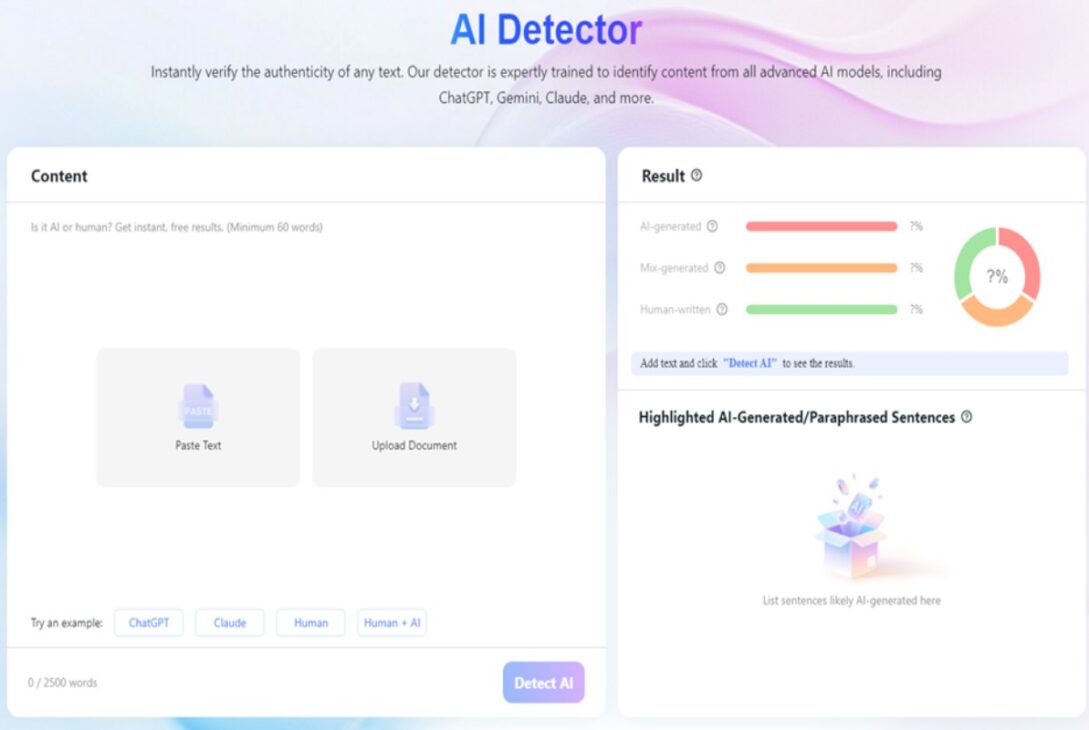
In the rapidly evolving landscape of digital marketing, academic integrity, and content creation, authenticity has become the new currency. With the advent of sophisticated Large Language Models (LLMs) like GPT-4, Claude, LLaMA, and Gemini, distinguishing between human-written and AI-generated content has become a critical challenge. Editors, educators, and SEO specialists are in an arms race against generative AI. While legacy tools like Grammarly and GPTZero have led the market for years, Lynote.ai is redefining accuracy in the niche of AI detection.
The Limitations of Legacy Detectors Grammarly is an indispensable tool for spelling, grammar, and style suggestions. However, its AI detection capabilities are often a secondary feature, tacked onto its core product. It focuses heavily on syntax and “perfect” grammar, which can sometimes lead to inaccuracies when detecting advanced, nuanced AI writing.
Similarly, GPTZero is widely regarded as the industry standard. However, as AI models have become more human-like, users increasingly report issues with false positives—situations where rigid but original human writing (especially in technical or academic fields) is flagged as AI. This can have devastating consequences for a student’s grade or a freelance writer’s reputation. Additionally, the cost of enterprise-level detection on these platforms can be prohibitive for freelancers or small boutique agencies.
Why Lynote.ai Offers Superior Accuracy
Lynote.ai boasts a 99% accuracy rate, a claim backed by its sophisticated training on the newest models. Unlike simple checkers that look for repetitive phrasing or basic keyword patterns, Lynote’s AI content detector analyzes the text at a deeper logical level. It looks at metrics like “perplexity” (how surprised the model is by the text) and “burstiness” (the variation in sentence structure and length).
Crucially, Lynote is designed to detect content that has been “humanized” or rewritten by other AI tools—a massive blind spot for many basic detectors. As “stealth writer” tools become more common, basic detectors fail because they only look for the raw signature of ChatGPT. Lynote looks for the underlying logic and flow that distinguishes machine generation from human thought.
Multi-Language Support for Global Business
One of Lynote’s strongest competitive advantages is its robust multi-language support. In a globalized market, content isn’t just in English. A multinational corporation needs to ensure the originality of localized marketing copy in Spain, Germany, or Brazil. Lynote can accurately detect AI-generated content in Spanish, French, Portuguese, German, and many other languages. This is vital for global teams that need to ensure quality control across all their operational regions, not just their English-speaking headquarters.
A Workflow for Integrity and SEO
For marketing teams, the risk of publishing AI-generated content without review is high. Search engines like Google are increasingly prioritizing “helpful, people-first content.” While AI content isn’t banned, low-effort AI content is often penalized. Lynote acts as a safeguard in your publishing pipeline.
It provides a detailed breakdown of which parts of a text are likely AI-generated, allowing editors to intervene surgically rather than rejecting or rewriting the whole piece. Whether you are a university professor checking essays for academic honesty or a content manager verifying freelance submissions to protect your SEO rankings, the need to check for AI writing is non-negotiable. Lynote.ai offers a solution that combines high-level accuracy with the nuance required to distinguish between a well-structured human argument and a machine-generated emulation.
Also read: The Benefits of Implementing a Software Management Program